Wednesday, October 07, 2009

Wall that be.

I went to the Superdeluxe club in the Roppongi district of Tokyo. I was late, having finished my work for a broadcaster at 22 hours.

As I arrived at the scene, a young artist started fighting against the wall. He first scribed unintelligible words involving "peace" and " will", and then painted them all over in blue. He used the hands and pressed them very hardly against the wall, as if rebelling against it.

When young, you are naturally surrounded by many walls, both real and imagined. When you get older and become mature, being able to keep seeing the wall that be is one of the manifestations of a creative mind.

In life, you've got to face the wall, more or less, and it becomes incumbent to decide your attitudes toward it.

Painting. What fantastic way to come to terms with the wall. You don't destroy it. You dance with it. By becoming one with the wall, feeling its physical brutality, you can give birth to a monster that is art. And then the monster breathes beautiful air.


A young artist fighting the wall in Superdeluxe.

Tuesday, October 06, 2009

Watershed

The return of Soseki Natsume from the two years' stay in London, in retrospect, was a watershed in the cultural history of modern Japan.

Records show that he was an excellent writer of English. His knowledge of the English literature was vast and deep, reinforced by intensive readings of volumes of the genre during his stay in the United Kingdom. Had he chosen to do so, he could have started a successful career in English prose, rather like Mr. Kazuo Ishiguro of contemporary times.

However, history had it that Soseki chose to write novels in Japanese, much to the benefit and enrichment of the Japanese literature for sure, but effectively closing the Japanese mind at the same time.

To date, considering the significant presence of Japanese economy, it is astonishing that Japanese intellectuals have produced so little in English writings. Surely, natural scientists do write papers, but then the expressions tend to be dry and do not reflect the subtle nuances of living on the island. It is a remarkable fact that there has not been an active English voice based in Tokyo, The Japanese scholars, especially in the humanities, have been primarily importers rather than exporters.

The result is a void in which the inner visions have never found a channel for expression. Such novels as "Memoirs of a Geisha" has strange connotations seen from a insider's viewpoint, as if the proportions are distorted and feelings were trodden on. The film "The Last Samurai" was in many ways a joke in facts and sensitivities.

These misrepresentations are all due to the lack of vigor in Japanese intellectuals in expressing the insider's viewpoint in the lingua franca, to the loss of both the island inhabitors and people at large.

Monday, October 05, 2009

Stream of consciousness

It is often said that the stream of consciousness was discovered by the great American psychologist William James. Needless to say, the stream has been with us always, ever since our birth, before WJ. It is only that the particular way of looking at our own experience, in its phenomenological dimensions in particular, solidifies and defines itself only with the explicit introduction of this concept.

Once in a while, during the course of the day, I would think about the stream of consciousness. How subtle are its manifestations. The ups and downs, the subtleties, multitudes of nuances, anticipations, apprehensions, sweets and bitters.

Even for a brief period of, say, one minute, it is not possible to give a full description of the stream of consciousness. We can only witness in helpless promised amnesia its magnificent processions before our own eyes.

The phenomenology of subjective experience is then a hopeless battle of the ever losing and being lost, rather like the explosive grandeur of Olivier Messiaen's Turangalîla-Symphonie.

What solace and disappointment to this mortal soul!

Sunday, October 04, 2009

Full moon

I have been up and doing recently, for quite a long time. Galloping has to stop somewhere and sometime. Now seems to be the time for reflection.

Took a deep dip in the hot spring. Tasted the water from the bathtub. Pondered how divine is every thing. Between earth and heaven.

In the Okinawa Islands, there is a saying.

The moon is beautiful on the thirteenth night.

The girls are beautiful in the seventeenth year.

When I look up at a beautiful moon, I am wont to think of this poetic song. I first heard it when I was 10. I have been missing its touch ever since.

When you do too much typing, you feel as if you were starving, as if your inner words reservoir was getting low. Then you read a beautiful essay written by a lonely soul. You feel replenished. You can go on again.

You have a full moon in your soul again.

Saturday, October 03, 2009

The burning heart

(Continued from yesterday's entry of "Tiger Jeet Singh".)

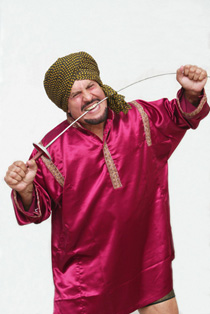
I hear that Tiger Jeet Singh is now a successful business person based in Canada. His real self is a rational man with cool judgments. Once on the ring, he becomes a wild beast, with a very unique fighting style.

In professional wrestling there are certain protocols. Beautiful girls dressed in kimonos would present flower bouquets to the fighters. The referee will explain the rules, and the fighters shake hands. Tiger Jeet Singh would have none of that.

Before the gong sounds, Tiger Jeet Singh is already on the offensive. Everything occurs out of the blue, without hesitation, with full vigor. He would swing his saber towards Anotonio Inoki, and the two fighters would fall out of the ring. Once out of the ring, it is a total chaos. Chairs would fly. Tiger Jeet Singh would chase Antonio Inoki, and the spectators would flee. The spotlight follows the fighters. The announcer would shout "Please take care! Please take care!". The announcer's cries of warning add fuel to the excitement.

After a while, the gong rings. Then the announcer would calmly say "now the match has begun". It is a very strange announcement. It is as if the nasty doings of Tiger Jeet Singh, clearly violating the rules, are being blessed in retrospect. It has been all O.K. The match is already in full motion.

The fighting style of Tiger Jeet Singh, in which he ignores the preparatory protocols of the match and just "goes for it" the moment he springs onto the ring, fascinated and thrilled me as a child. I have been trying to imitate the style in real life ever since.

When you are attending a conference, or on a committee, there are people who like to say polite but meaningless things. I ignore the mannerism, and just go straight to the essence of matters. The spirit of Tiger Jeet Singh is in me. I don't have a saber, but I have the burning heart.


Classic. Tiger Jeet Singh showing his emotions.

Friday, October 02, 2009

He really means it!

When I was 10, my then best friend Toshikazu Shimamura took me to see a Professional Wrestling match. The fight was between Antonio Inoki and Tiger Jeet Singh.

We were waiting for the arrival of wrestlers in front of the Koshigaya City Gymnasium. Toshikazu was a great fan of wrestling. He would give me many advises towards the appreciation of this genre.

As we were standing with great expectations, Toshikazu warned me:

"The other wrestlers are just make-believers. Tiger Jeet Singh, alone, is different. He really means it! If you meet him in the eye, he is sure to attack you. So don't you ever look him in the eye. I adviser you on this, for your life."

So I had serious apprehensions as Tinger Jeet Singh himself got out of the minibus and stormed towards the gymnasium. As Toshikazu was warning me, he seemed to "really mean it". His countenance was menacing, with his trademark saber in his mouth.

When I look back, I wonder why his act did not violate Japanese swards and guns control law. It certainly looked like he was violating it.


Tiger Jeet Singh with his trademark saber.

Thursday, October 01, 2009

Turner Island

In the suburb of Matsuyama, off the coast, there is a small island. It is famous as Soseki Natsume referred to it as the "Turner Island" in his novel Botchan.

On Tuesday I was on the boat off Matsuyama, being gently swayed by the waves. There it was, a chunk of rocks with pine trees growing on it. Its beauty struck me immediately. The impression deepened with the lapse of beholding time.

So this is the Turner Island, I thought.

Soseki named the island as such because it appears to be a scene fit for a depiction in a work by the great painter. Two antagonists in the novel, nicknamed "Red Shirt" and "Field Drum", go fishing on the boat with the protagonist "Botchan". The Red Shirt and Field Drum discuss the Turner Island, to the amusement of Botchan. It is a very memorable passage in the novel.

I did not expect that the island would be so lovely. Soseki certainly had an eye for the beautiful, even when the affection was expressed with wit and sarcasm.

Now my mind's image storage has curated the Turner Island in its collection.


The "Turner Island" off the coast of Matsuyama.

Wednesday, September 30, 2009

Friendship

My second day in Matsuyama, and I have been pondering the friendship between Soseki Natsume. and Shiki Masaoka.

Soseki is the father of modern Japanese literature, and Shiki is the founder of modern Haiku poems.

Shiki was born in Matsuyama, and Soseki came to teach in the city after graduating from University of Tokyo. Soseki based his novel Botchan on his experiences in this southern city on the Shikoku island.

That Soseki and Shiki both went on to achieve great things in literature is not independent of their friendship. Soseki and Shiki knew each other in the preparatory school for the university already. They exchanged views on literature. Soseki wrote many Haiku poems which Shiki read and made comments on. During a particularly intensive period of 50 days, Soseki and Shiki stayed at the same house, now reconstructed in a park in Matsuyama.

The friendship between people of the same sex is one of the most beautiful things in life. Records suggest that Shiki and Soseki were attracted to each other from the beginning, acknowledging the special qualities of the counterpart.

Shiki died at the premature age of 35. Three years later, Soseki wrote his first novel "I am a cat". Shiki had an ambition to be a novelist himself, but his short life under the shadows of tuberculosis did not allow a full development of his aspirations.

One could only imagine how Soseki felt as he looked back on his soul mate, who shared literary ambitions in the youth.

Soseki himself died at the age of 49. His last novel, Mei an (Light and Darkness) , was left unfinished.

Tuesday, September 29, 2009

A brain the size of Kent

I am in Matsuyama, for matters concerning the great writer Soseki Natsume.
On the way to Matsuyama airport, I was reading the book "Oscar Wilde. Nothing...Except my genius. A celebration of his wit and wisdom' (Penguin books, 1997). A quite lengthy essay 'Playing Oscar' by Stephen Fry in the book was very enjoyable.

-----------

And what of Wilde the man? He stood for art. He stood for nothing less all his life. His doctrine of art was so high that most people thought he was joking. The English, who to this day believe themselves quite mistakenly to be possessed of a higher sense of humour than any other nation on earth, have never understood that a thing expressed with wit is more, not less, likely to be true than a thing intoned gravely as solemn fact. We, British, who pride ourselves on our superior sense of irony, have never fully grasped the idea of fiction--of ironism. Plain old sarcasm is about our mark. When Wilde made an epigram, it was at best, 'clever'. Clever, like funny, is an English insult of the deepest kind.

'Playing Oscar' by Stephen Fry
-------------------

I love Stephen Fry. He was once described as "a man with a brain the size of Kent." I appreciate Stephen's effort to come to terms with the phenomenon that was Oscar Wilde.

Monday, September 28, 2009

High tension

I had an interesting dialogue with my best chum Takashi Ikegami, at the Aoyama Book Center in Tokyo.

It was meant as a launch event for my latest book (translated as "Symposium of the Brains"), but we talked out of the context as always.

I tend to judge people by the high tension. Takashi's tension is as lofty as ever. It flies sky high. His day time job is professor at the prestigious University of Tokyo, but he wears Aloha and jeans during office time all the same. Fashion statement is a wonderful channel of philosophy. I have weathered this whole year with only a single pair of trousers and jacket, augmented by a collection of T-shirts.

I am always looking for a person with high tension. When your counterpart is earnest, full of energy, and committed, through the dialogue one can fly high up in the air. Last night, with Takashi, the whole audience witnessed lofty mountains and distant oceans. The cityscapes of Tokyo diminished into the background.


High tension professor in aloha. Best chum Takashi Ikegami.

Sunday, September 27, 2009

Audience laugh

Giving a talk is part of my life. I am invited to give a talk from various quarters, but I cannot comply with most of them. I have to say no to ~95% of the invitations, much to my regret.

I gave a talk in Hakata this Saturday, to an audience of about 1700. The lecture was organized by Mainichi Shimbun, one of the largest newspapers in Japan.

When I give a talk to the public, I naturally touch upon my own expertise, namely the brain sciences. At the same time, I try to make the talk as entertaining as possible. To that end, my experiences in childhood attending the Yose comic shows prove useful.

At the Yose, several entertainments are provided. The most staple form is Rakugo, Japanese traditional sit-down comedy. My father and grandfather liked listening to Rakugo at the Yose, and I was often taken to the performances in my childhood.

Although I did not realize it for a long time, when I give a public lecture to the general audience my childhood sojourns to Yose help me very much. I feel happy when the audience laugh.


Myself giving a talk this Saturday in a theater in Hakata.

Saturday, September 26, 2009

At the Imperial Hotel

I gave a talk at the Imperial Hotel, Tokyo. The hotel is preparing itself for its 120th anniversary. I was invited to speak on serendipity, which has been chosen as the ethos word for the special occasion by the president of the hotel, Mr. Tetsuya Kobayashi. After the talk, I had a lively dialogue with Mr. Kobayashi on the nature of making most of the chance meetings we have during the course of our life.

Mr. Kenichiro Tanaka, the chief chef of the hotel, prepared a special dinner for us. Mr. Tanaka has been a guest on The Professionals program that I host, so that I am familiar with his warm ways of communicating with people. It was a pleasant evening.

The Imperial Hotel is a national institution. Initially organized as a Western style hotel to welcome foreigners to Tokyo after the opening of the country to the outside world after the Meiji Restoration, it represents the finest in the tradition of deep-running hospitality. Although on the surface it is very western, in spirit the finesse remains uniquely Japanese.

This particular blog is in part an experimentation on expressing the world view and sensitivities of someone who was born and brought up in Tokyo, in the lingua franca that is English. In a sense, I feel the Imperial Hotel is trying to do the same thing.


At the Imperial Hotel main entrance. With president of the hotel Mr. Tetsuya Kobayashi and the chief chef Mr. Kenichiro Tanaka.

Friday, September 25, 2009

The brat element

I think I was a dirty brat. During the elementary school days, I used to take a bath with a book in my hand. Often, I did not wash at all, and would get out of the bath where the only difference was that I have progressed with the reading of the book by several pages. My mother used to accuse me of "a crow's bathing", after a popular expression in Japan referring to a bath taking without the cleansing elements.

As a result, my hair would often get oily, as if a natural additive was applied to the head shrub. I was literally an oily boy.
Nowadays, I take shower and wash my hair every morning. And yet, I do not distinguish between soap and shampoo. Most often, I wash my hair with a bar of soap. The brat element has not left me.

Thursday, September 24, 2009

Dinner party

I was invited to a dinner party in honor of the Archbishop of Canterbury, Dr. Rowan Williams, at the British Embassy in Tokyo.

I was introduced to the Archbishop by the British Ambassador to Japan, Mr. David Warren. Mr. Warren is a warm man with a robustness of quick wit and sound judgments. It was a great pleasure to accept Mr. Warren's kind invitation to this special dinner.

Dr. Williams was educated at Cambridge and Oxford, and is known for his liberal views on the role of the Anglican Church. He is an poet in its own right. Before the dinner, some of his poems were set to beautiful music by members of British Embassy choir.

At dinner, I sat next to The Bishop of Leicester, The Rt Revd Timothy Stevens. I had a lively conversation with Tim.

During the conversation, something struck me.

I said to Tim, "you know, something just struck me" "What is it?" "Well, it just occurred to me that in English culture, at a dinner table like this, people carry on talking as if the food on the table does not matter." "Yes, it is probably very much true." "My mentor was Prof. Horace Barlow at Trinity college, Cambridge, and I sometimes had dinner there. I remember well how people appeared not to pay any attention to the dishes on the table, which were actually excellent. Why is it?" "Well, as an English person, I probably don't realize the reasons for the particulars of my own culture. Probably the English people do not think what you eat is very important in your life."

After the dinner, during the port, I was discussing the London Underground, and a question arose. Mr. Jason James, Director of the British Council and the Cultural Counsellor at the British Embassy, told me he would send an e-mail later on why the underground card is called "Oyster".

Here's the e-mail from Jason.

-------------
Subject: World is your oyster
From: Jason James
To: kenmogi

According to Brewer's Dictionary of Phrase and Fable, the expression "the world is his oyster" means 'the world is the place from which he can extract success and profit, as a pearl can be extracted from an oyster.'

A quote from Shakespeare is given:

Falstaff: I will not lend thee a penny.
Pistol: Why, then the world's mine oyster,
Which I with sword will open.

(Merry Wives of Windsor, II, ii (1600))

These days, it just means "You have complete freedom to do whatever you want.' It is usually used with reference to people's career prospects - e.g. we might say that if someone gets into Tokyo University "the world is his/her oyster."

Best regards,

Jason James
-----------------

On the way back on the taxi, I received a phone call from the Kabuki actor Ichikawa Ebizo, who has just returned from a successful performance in Monaco. Ebizo is going to Hakata this weekend for his performance there in October. I commented how super his Roppo action was during his performance of Ishikawa Goemon with his father Ichikawa Danjuro.

Wednesday, September 23, 2009

A good gardener

The brain is able to adjust its functions according to the particular context in which the subject is expected to do well. For example, cramming for the entrance examination is a context. Common sense tells us that those who do well in the cramming context do not necessary perform excellently in the general arena of life. It is simply because the contexts are different.

The orbitofrontal cortex, together with other related circuits in the brain, is responsible for the fine tuning of the coordination of brain's various circuits so that it functions properly in the context given.

It is one thing to do well in the particular context that one confronts at a particular time. It is another to choose the context in which one is supposed to perform, with minute care and unlimited imagination.

Many people, as life progresses, falls into a particular pattern of context, and learn to do well in it, but fails to have a metacognition of the context itself.

Choosing the context is an art of cultivating the vegetation that is the self, which can grow only slowly and by daily customs. One must be a good gardener in the "plantation" of the brain, making decisions on the context setting with wisdom.


The orbitofrontal cortex (from Wikipedia)

Tuesday, September 22, 2009

The magical transformation

Yesterday, there was a shooting for the "Untitled Concert" (Daimeino nai Ongakukai) program conducted and introduced by Yutaka Sado. The Untitled Concert program is broadcast by TV Asahi weekly. The venue was Opera City, in the metropolitan Shinjuku district.

The theme was the music of Antonín Dvořák.

I appeared as a guest, and had conversations with Yutaka Sado, accompanied by the master of ceremony Ms. Naoko Kubota.
Yutaka Sado is an extraordinary man.

A conductor, by the very nature of his job, remains silent. He is, in a sense, deprived of speech. The only way to express himself is through the baton, and the orchestra does the actual physical expression for him. Because of the deprivation of voice, the conductor becomes passionate. The volcanic fire comes from the non-existence of speech.

Therefore, it is an unusual and difficult job to alternate between being a speaking person on one hand, with all the friendliness that one can command, to reach the general audience, and being speechless on the other, putting all one's existential weight on the baton.

Yutaka Sado does exactly that. Now he is talking expressively about the charm of Dvořák. The next moment he is conducting, with the baton as his only way of expression. Yutaka is speechless, while the orchestra plays heavenly music. The magical transformation has been accomplished.


With Yutaka Sado and Naoko Kubota on the stage from an earlier broadcast.

Monday, September 21, 2009

Vulnerable for change

Being assertive is important in life. Without putting forward one's values and opinions in an explicit way, nothing changes in the tranquility of the universe. On the other hand, I think it is equally important to be a skeptic, being doubtful of one's own view.

From time to time, I encounter people who are quite positive about what they think and feel. When there isn't an accompanying element of self doubt, I feel a bit strange. I get suffocated even, having the sensation of being driven up against the wall. It is actually those people who are cornering themselves towards dead ends.

By being doubtful of the self, one opens the door for learning and growth. Looking back on my own past, I realize that I have never been completely sure of what I held to be my own opinion. There was always a remnant fluctuation, a vibrating center of the self swayed to and fro by the invisible wind.

I am very proud of my vulnerable nature. Being vulnerable for change is the only way of life.

Sunday, September 20, 2009

Chitty Chitty Bang Bang

When I was around 10 to 15 years old, I really loved the musicals. As I recall, the film that kick-started the whole thing was Chitty Chitty Bang Bang, which was shown in a local film theater when I was 10.

When you think about it, the way some memories are associated with a particular period of life is strange. I vividly recall that I was exactly a 5th grader when I saw the film in the darkness of my favorite film theater.

As one gets older, memories are not so well designated to a specific period. For example, it is sometimes difficult to temporally pin down the initial viewing of some memorable films (e.g. Solaris, El Sur, L'Albero degli zoccoli) that I encountered in my 20s. The childhood days are marked by vivid and colorful progressions of time. As one passes adolescence, the segmentation of time becomes less clear.

Back to Chitty Chitty Bang Bang. There were some features of the film that captured my imagination. For example, the contraptions that the mad inventor father (played by Dick van Dyke) builds in the film fascinated me. One of them cooked an egg and made a sandwich at the breakfast table, with some disastrous results.

There were some lovely tunes, like "Doll on a Music Box", where Truly Scrumptious (played by Sally Ann Howes), pretending to be a mechanically constructed doll, dances on a music box, ostensibly presented as a special gift to the tyrant Baron Bomburst.

There is a clip of this beautiful scene on youtube.

Looking back, the whole film is lovely, as in it the adults endeavor to entertain the children and children-at-hearts very seriously.


A scene from Chitty Chitty Bang Bang.

Saturday, September 19, 2009

Visually stunning drama

I went to the Kabuki-za theater in the central district of Ginza, Tokyo with my editor Ms. Yoko Oba, and Ms. Ayako Taniyama, who illustrates my essays on history in the Mainichi Weekly magazine.

One of the acts was Kanjincho. Although I have seen it many times, each time the experience is knew. A lot of discoveries are made, as is the testimony of any great classics.

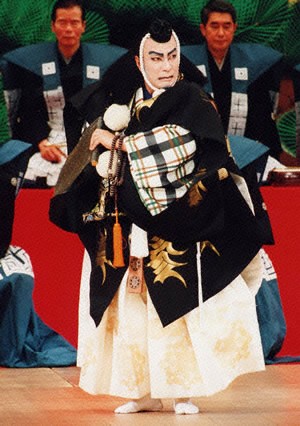
This time, I was drawn to the visually stunning dramatic structure, in which the protagonists struggle, negotiate, get infuriated, and finally arrive at a humane and moving solution. It is as if a symphony is played out in front of your eyes using the bodies of actors, who are made up in exaggerated contrasts and dressed in conspicuous attire. The score is written in the implicit traditions of bodily language which have been handed down through the generations for hundreds of years.

The actors remain constrained in their bodies, and yet their expressive powers transcend time and space.

It was one of these moments when one realizes the bliss of a life in Tokyo. I simply love Kabuki.

The theatrical treat was followed by a culinary one in the Sushi restaurant Tsukasa, where the finest specimen of Maguro are procured and served through the eyes of Mr. Hiroki Fujita.


Visually stunning drama. A scene from Kanjincho.

Friday, September 18, 2009

A diligent boy

From time to time I wonder: If I lived this time as a small school boy, what would I have done? How would I have felt about the goings on the world, how would I regard the people around me? How would I breathe in the air which is the beginning of the 21st century?

Occasionally, I encounter kids who remind me of my own youthful days. I observe them with great interest and empathy at these times, as they appear to be the echoes of my emotional and intellectual life of the past.

While vacationing in Taketomi island last extended weekend, I glanced upon a boy by chance. He was reading a book while strolling the venerable street of Taketomi, flanked by age old coral walls. The boy was deeply absorbed in his reading. From time to time, he would raise his eyes, and watch us strangers from a big city afar.

What kind of mental life is he nurturing, I wondered. How would it feel to be born and grow on this lovely island of a population of 342, with just 172 households, where everybody presumably knew everybody else?

How would he absorb the flying clouds in the sky? Would he be astonished by the great fruit-eating bats flying in the darkness of night? Would he pick up the seashells on the shore? Would he accumulate knowledge about the beautiful butterflies that inhabit Taketomi? Would he dream of going to the big cities, to attend places of higher education?

It was not likely that my life and his life would cross again in any significant way. However, that afternoon, on the coral island of Taketomi, my life resonated with the life of a diligent boy, leaving a bittersweet aftertaste.

I wish all the best in life for the little soul.


The diligent boy on Taketomi Island

Thursday, September 17, 2009

A swarm of bacteria

The speed of the evolution of bacteria is rapid, as it multiples very rapidly, with corresponding changes of generation. It is natural that species of bacteria develop resistance to antibiotics within a short period, given the rapidity of its multiplication.

Humans, on the other hand, cannot reproduce so rapidly. The human evolution has taken another strategy.

Human evolution is characterized by sustainability, supported by the longevity of individuals. Although the "self" maintains its identity over decades, the elements that compose the self multiply and perish within a very short period.

Humans, in a sense, is a "habitat" in itself, in which the evolution of constituent entities occurs. Humans evolve most efficiently when behaving like a swarm of bacteria.

Wednesday, September 16, 2009

Butterfly road

Breathing in the air on the subtropical Tametomi Island, old memories came back to me.

In February 2001, I traveled to Taketomi Island with some of my best friends. Notably, Yukio-Pegio Gunji was there.
On the first afternoon, we rented a bicycle and pedaled towards the beach. There was a small path, with weeds growing from both sides. As we sped through the vegetations, butterflies flew out of the shrubs and encircled us. Their wings deformed and changed positions in the air, like flower petals dancing in the wind.

It was a beautiful and yet fundamentally comical scene. We felt as if we were in a classic film. Some scholars and students dedicated to the research of complex systems riding the bike on a small island, with butterflies celebrating our efforts. The vision was striking and poignant. It stays with me to this day.

On this particular visit to the island, we made it to the butterfly road again. I found the path to be a little bit wider than in memory, perhaps due to an expansion work that has been done. Due to the seasons or other elements, there were less butterflies in the air, so I missed the replay of the movie scene with Yukio-Pegio Gunji.


The butterfly road revisited.

Tuesday, September 15, 2009

We somehow coped

I love the night breeze on a southern island. As we finished our dinner and gently walked home through the narrow paths, I looked up at the sky. There were stars. The milky way was clearly visible. Before knowing it, almost unconsciously, I was searching for the giant fruit-eating bats, which are characteristic of the subtropical islands around Okinawa.

I could not find one. Mrs. Maki, owner of the restaurant Maki, our favorite hanging-out place on the island of Taketomi, told us that there were less fruit-eating bats now, especially after the unusually strong typhoon that hit the island last summer. "Before that", she said, "the bats were flying over that tree beyond the house".

Without the blessing of the bats, we somehow coped. The night was as dark as it used to be, without the air-bound creatures which used to enliven the blackness enshrining our existence.


Every cloud has a silver lining. The magic of the sunshine on Taketomi island

Monday, September 14, 2009

Transformation

Sunday came, and I traveled to the southern Island of Taketomi, one of the Ryukyu Islands. The district is called Okinawa, after the biggest of the Ryuku Island of the same name.

When I travel southbound, I go through a remarkable process of transformation. It is especially true in the case of Okinawa.

The moment I get off the plane, the process starts. I am in a mood to take off my belongings from civilization, e.g. the watch and socks. The tendency gets stronger as I travel further from the airport, cross the ocean on a boat to arrive at a small island, like the Taketomi island.

I prefer not to take any job to an southern island, as I would like to relax without caring about what I have to do. However, sometimes I am obliged to take some assignments, as in this particular trip. This morning, while my students were visiting the Utaki (sacred places in Okinawa Style), I was busy typing my manuscript on a desk in the gardens of the Minshuku we are staying.

As I worked very diligently, I could finish my job before noon. I spent the afternoon taking in the sunshine and the wind in a westward-looking beach.


The sunset in Taketomi Island

Sunday, September 13, 2009

The Chicago rain

This Saturday in Tokyo was characterized by occasional rainfalls, which became quite strong from time to time, verging on being a pouring rain. As I move around in cars, I did not have to use an umbrella. I do not mind the rain so much when I do not have to cover the space above my head with the nuisance of an umbrella. I hate separating myself from mother nature.

I love to listen to the rainfall in the safe haven of the indoors. It is simply scrumptious to read a favorite book on the sofa, while occasionally paying attention to the rhythmical sound of the raindrops.

As I recall. there was a particularly memorable rainfall in Chicago. I was 22, and was attending the 38th Japan America Students Conference. As the schedule on that fateful day was to meet with some important people, we had our best suits on. The day started with a bright sunshine, so we did not expect anything nasty to happen weatherwise. An American participant told me how there were flats in the skyscrapers in Chicago. The residents living in the upper floors are "above the cloud level", so that they sometimes have to ask a friend on the "earth level" how the weather was down below. The story amused me. There was apparently no need to worry about the weather on that day.

I was mistaken. We were all wrong. Suddenly, a black cloud gathered in the sky. Literally in minutes, the rain started to fall with a vengeance. We were in the middle of an open space, and there was simply nowhere to hide ourselves. Needless to say, nobody had an umbrella. We became soaking wet.

As abruptly as it started, the rain stopped without warning. The sun came back, and we were soon basking in the sunshine, while the water dripped from our noses and sleeves.

Alex began to laugh, with the characteristic, whole-hearted laughter that was Alex. I began to laugh, too. There was something amusing and refreshing in that savage exposure to the wild weather of Chicago. It was as if we were embraced and kissed by mother nature herself.

The experience was divine, and I remember it vividly to this day. The Chicago rain is one of my favorite wet memories.

Saturday, September 12, 2009

Professor Higgins

I was 10 or so when I first saw My Fair Lady (film). I was immediately fascinated by the whole ambience. At that time, video recorders and video tapes were not widely available. So I bought the sound tracks in the LP format and listened to them. It was my first lessons in the English language.

The character of Professor Higgins, played by Rex Harrison, captured my imagination from the beginning. I do not know what was so significant. His manner of getting to the point with the speed of lightening, his devotion to the study of speech, the accompanying and inevitable dropping of all considerations of material and domestic needs, was an inspiration.

When I traveled to U.K. and had a chance to have interactions with the English academics, I found that the Higgins type is not rare. Higgins are everywhere. They have their peculiarities, quick wits. The eyes are cast at nowhere, their minds apparently occupied by unearthly things.

The speech and actions of Professor Higgins is a music in itself. It was so beautifully portrayed by the late Rex Harrison that the world owes a heritage to him. I, for one, owe a youthful inspiration which probably helped my scooting towards the fanciful worlds of intelligent endeavors.


Professor Higgins (Rex Harrison) offering chocolates to Eliza Doolittle (Audrey Hepburn).

Friday, September 11, 2009

Not an easy place to live

I knew that Glenn Gould, my favorite pianist, used to like reading Kusamakura (Grass Pillow) of Soseki Natsume. Naturally, I have read the original Japanese version (many times), but have never ventured to tackle an English translation.

For some reasons, Kusamagura has been hanging on the verge of my consciousness recently. The other day, I finally bought the new translation by Meredith McKinney, published from Penguin Classics.

The famous opening sentences are translated thus:

--------------

As I climb the mountain path, I ponder--
If you work by reason, you grow rough-edged; if you choose to dip your oar into sentiment's stream, it will sweep you away. Demanding your own way only serves to constrain you. However you look at it, the human world is not an easy place to live.

From Kusamakura: Translated by Meredith McKinney, Penguin Classics

---------------

I think it was Soseki's pessimistic observation that haunted my soul when I first read the novel as a child. It is, however, a pessimism with a vital force to go forward. Soseki apparently wrote the whole novel in a matter of a week, if we take his words literally.

Pessimism, or acknowledging that existence can never be perfect, is the founding stone for a vigorous life. It is the source of great works of art. There is wisdom in educated pessimism.

Although I am generally regarded as an optimistic person by my friends, I must say that there is always a tinge of pessimism in the way I regard the world.

Thursday, September 10, 2009

Lights are everywhere

The other day I visited a temple in the Hieizan mountain near Kyoto.

I met with The Great Ajari Yusai Sakamoto, who completed the Sennichi Kaihogyo (1000 days of intensive and life-or-death journey through the mountains) twice.

As I was leaving the quiet sanctuary, I looked back. There were rays of sunshine permeating through the woods. There is such a magic about lights going through the air, when they are made visible.

Even when we cannot see, the lights are everywhere, permeating, being reflected, shining on, and emanating from.

The rays in the woods stood in my mind as an example of invisible things, which surround our life. When made visible through the workings of rare conditions, they appear to us as heaven-sent miracles, but earthly all the same.


Light rays permeating through the woods.

Wednesday, September 09, 2009

Why doesn't he write and find out?

From my own experience, and from the general brain scientific point of view, writing has a special significance for the brain.

My mentor at the University of Cambridge was Horace Barlow. Once, Horace was organizing a conference. One of the participants did not send in an abstract. When contacted, the negligent participant answered that he did not know what he should write in the paper. When the postdoc who was functioning as an assistant for the conference reported that reply, Horace immediately said:

"Why doesn't he write and find out?"

Horace's sharp comment cuts right into the essence of the cognitive processes involved in writing. When writing, one often consciously perceives chunks of information which has been dormant in one's unconscious. Writing provides a channel between one's conscious and unconscious.

Tuesday, September 08, 2009

Yutaka Ozaki

There are certain cultural phenomena, which, due to the language barrier, cannot transcend easily to other nations. These are hidden treasures, screened from people of other cultures at a great loss to the knowing and unknowing parties.

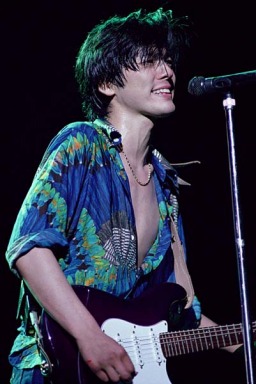
Yutaka Ozaki is one of them. A legendary singer-songwriter, he died at the premature age of 26. The wikipedia entry , at its present rudimentary state, simply does not do justice to this great musician.

Yutaka Ozaki sang about youthful dreams, anxieties, and love. The young spirit is sometimes rebellious towards the status quo, for the very good reason that the fiery energy cannot be contained in a conventional social structure.

Yutaka Ozaki's song, while being an anthem of rebellion, eventually deepens into a love which is all-encompassing, including those against whom the young artist expressed his mistrust in the lyrics. Overcoming the obstacles, Yutaka Ozaki's songs attain the universal value of a great art.

My favorite Yutaka Ozaki songs include "I love you", "Oh my little girl", "Graduation", and "Singing to the Wind" (Kaze ni Utaeba).


Yutaka Ozaki (1965-1992) at a concert.

Monday, September 07, 2009

Liquid in life

I had a public dialogue with the designer Taku Sato. in the Les Deux Magots Cafe Tokyo, Shibuya. Taku is widely known and appreciated for his design of packages, in which he depicts, in the utmost simplicity and elegance, the essential properties of a particular brand.

When I have a discussion in public, I rarely meet the counterpart beforehand. I prefer to let the conversation follow its own life force ad libitum, rather than to adhere to a designated structure.

The spontaneous verbal exchanges with Taku last night was exceptionally successful, thanks to the gaiety of his spirit.

Taku said that surfing has been his passion for more than two decades, and described the experience in precise and poignant words. Taku's reference to the oceanic sport on the waves led us to the appreciation of the liquid in life.

In civilization, we are tend to be surrounded by solids made of steel, concrete, and other infrastructures. Given the unavoidable trends, life continues to thrive, gets to its highest points, in liquids. That something which is without any definite shape, always changing, breaking our expectations, calling for a total engagement by the body, shifting, penetrating, mixing, gorging, going over everything, into everywhere, becoming time itself in its transitions. That something, ubiquitously liquid.

The lively conversation with Taku left a vivid and viable aftertaste. I thrive in that tone today.

Here's to the liquid in life.


With Taku Sato in the Les Deux Magots Cafe Tokyo.

Sunday, September 06, 2009

Beetle mania

The earliest memories have the strange impressions of defining the mythical in one's life.

Some memories during my kindergarten days stand out very vividly. One of them concerns the Japanese rhinoceros beetle.

Kabutomushi (Japanese rhinoceros beetle) has a special place in a kid's mind. It is a symbol of desirable things, and kindles the heart of the child in a way which is not simply comparable with any material possessions in adulthood.

It was the summer. I was five. Ms. Arai, our teacher, was playing the piano in the Kindergarten room. Suddenly, she acclaimed something on the black wood. It was a Japanese rhinoceros beetle. Moreover, it was the much desired male, with the strong horn protruding from the head. Nobody was quite sure how the beetle got onto the piano in the first place.

There was a commotion among the boys. Ms Arai, holding the beetle in her fingers, let us admire its beauty. It was a particularly fine specimen.

Ms Arai, apparently wanting to get rid of the creature as soon as possible, turned to a friend of mine near the piano, and said "Here. This is yours". She gave the Japanese rhinoceros beetle to the boy.

I became jealous. Oh, how I wanted that beetle! The fact that Ms Arai was very popular among us five year olds gave a further fuel to my jealousy.

It is the first memory of envying other in my life.

Adults might laugh at a kindergarten boy desiring a Japanese rhinoceros beetle. The mental life of a child is colored by primitive and yet finely tuned emotions. I vividly remember the flame set by the envious beetle to this day.


A Japanese rhinoceros beetle

Saturday, September 05, 2009

Whims of nature

Clouds are always up in the sky, yet we do not attend to them. From time to time, when the shapes strike us as massive, and the angle of the light is just fine, we take notice of them.

Yesterday, there was such a magnificent cloud in the sky. I looked up admiringly, unable to have enough of it.

The physical process is continuously there. With the vapor circulating, the wind blowing, it never stops. The fact that only a subset of the ever going procession draws out attention is a testimony to the whimsical nature of our perception. Because of the whim, we are led to some beauties and truths, while missing others.

Clouds are themselves like whims of nature.


A magnificent cloud seen in the sky yesterday.

Friday, September 04, 2009

It's my job never to give up

Back in Tokyo, I am already immersed in a hectic work schedule.

I had a quite stimulating dialogue with Dr. Hisashi Matsumoto, who is a flying doctor on board a "Doctor Heli" helicopter based in Chiba prefecture. Dr. Matsumoto was the guest for "The Professionals" program in NHK.

In the studio, Dr. Matsumoto stressed the importance of outreaching for the medical service. The emergency treatment in a life or death situation is very different from the medical procedures in general. It was intellectually exciting and eventually emotionally rewarding to learn the difficulties and possibilities of emergency medicine.

"You see, we never give up".

Dr. Matsumoto said.

"It is nothing special. It's my job never to give up, to save the patient."

Dr. Matsumoto flies on the helicopter to give emergency treatments more than 600 times a year.


In the NHK Professionals studio. With Dr. Hisashi Matsumoto and Ms. Miki Sumiyohi.

Thursday, September 03, 2009

Home coming

It used to be that when I go abroad and come back to Narita airport, I get into a mental zone of inverse cultural shock, finding the atmosphere of my home country somewhat strange, as if I am witnessing it through the eyes of a foreign visitor.

Nowadays, the transition is more smooth. But the metacognition runs deep.

Each culture has its own merits and limits. I seem to discern more accurately the scopes and borders of the context of my native culture, as I shuttle between Japan and abroad. It is not that the context of the English-based civilization, for example, is broader than that of Japanese-based civilization. It is just that they are different.

Home coming has a bittersweet aftertaste. As I get into the rapid train connecting Narita airport and central Tokyo, recollections of the London atmosphere rapidly disappears, and I am left to adapt to the familiar cultural contexts of my mother country, in which I sometimes feel like a stranger.

But then I would feel like a stranger in any single cultural context, mother or foreign.

Wednesday, September 02, 2009

A Farewell to Arms.

On my final day in London, I visited the British Museum with my co-travelers, and talked to Mr. Timothy Clark, head of the Japanese Section. Tim was kind enough to show us how the works of art are stored and preserved, and used to support research and exhibition when necessary. I was impressed by Tim's enthusiasm for the preservation and understanding of Japanese art, especially Ukiyo-e prints and scrolls.

I spent the last few hours in London drinking ale beer in a Kensington pub with my friends. We had a jolly good time, judging from the number of laughters and jokes, which sometimes hinged upon the ridiculous.

Finally, it was time for me to catch a taxi for the airport. My fellow travelers were to stay one more night in London. As I got into my taxi, their arms were stretched out towards me. We shook hands.

As my taxi started to move, their arms remained invigorated. It was a sentimental moment. As I watched my friends waving their arms, I bade a farewell to arms.

Tuesday, September 01, 2009

The sublime in Turner

I visited Tate Britain and the National Gallery in London. One of the main purposes was to see the paintings by John Mallord William Turner.

Turner is mainly known for his paintings of scenery, especially those of the ocean, where the colors are mingled in a harmonious manner, to give an overall impression of fogginess and vibrancy.

Turner, however, also painted more concrete and "real" works, especially those based on war themes. The drawings and water colors of Turner demonstrate the precision with which the artist was able to capture the details of the subject, if and when he willed so.

Turner's paintings, at their best, give the impression of the "sublime" to the observer. In being merged in the sublime, things lose their individualities. For the purpose of the depiction of the "sublime" in this sense, the ocean, where the water and the lights and winds are in constant motion and resonance, was arguably the ideal subject.

With the traditional methodologies of painting of which Turner was a master, the artist is able to reproduce a particular impression with a degree of much higher exactness compared to the more contemporary methodologies such as installation.
As the artist is able to control every brush, the impression can become more finely tuned as the picture gets abstract in the conventional sense. Being abstract does not signify a loss of information in the case of Turner. Being abstract is the language for the faithful depiction of deep emotions and feelings, which the artist pursued all his life.

The innovations and aesthetical investigations to be found in the art of Turner gave the inspiration for the Turner Prize, which is in a sense a celebration of the continued evolution of the sublime in contemporary art.


The Sunrise with Sea Monsters (circa 1845).
One of my favorite Turner paintings.

Monday, August 31, 2009

London photos.

I came to London for a magazine and book cover trip of the Tate and British Museum. I am staying just for two nights and then will be flying back to Tokyo. Accompanying me are Michiaki Watanabe and Shinzo Ota of Shogakukan publishing, and Shinya Shirasu.

Shinya's friend, Akio Shindate joined us. Shindate has founded a design company VO Corporation based in Kensington.

Since I have lived in U.K. for two years, and have frequently visited London ever since, landscapes in London fills me with much nostalgia and a sense of home coming when I see them.

The U.K. is like a second home for me.


Familiar signs in London Heathrow airport


The taxi stand at Heathrow airport


The Natural History Museum, taken from the speeding Taxi window.


Harrods. Ditto taken.


Hyde Park. Ditto taken.


The Piccadilly Circus. Ditto taken.


The entrance of the Soho hotel.


The Soho hotel room.


A late night drink with Shinya Shirasu, my soul mate.


A Thai dinner at the Patara restaurant in Soho with Michiaki Watanabe, Shinzo Ota, and Akio Shindate. Shinya Shirasu could not make it for the dinner as his luggage was delayed at Heathrow.

Change has come to Japan

In a democracy, people have the power to oust the king, no matter how powerful he may be.

For the last 25 years, I have been voting for the opposition, except for one rare occasion when I voted for the ruling party.

The result of yesterday's general election suggests that for the first time since 1955, (except for a 10 months period in 1985), the opposition is going to form the government.

For somebody who has been feeling like a stranger minority in a more or less homogenous society, this victory of the opposition brings a very strange aftertaste. Much as I love the country, I was under the impression that the Japanese people are not so good at breaking the status quo. I was pleasantly surprised.

Because of what we did yesterday, change has come to Japan.

Sunday, August 30, 2009

Born to be wild.

Although the ending of the film is rather sad, the opening scene of "Easy Rider" always thrills me when I watch it.

"Born to be wild" by Steppenwolf is such an inspiration. The scene has entered the canon of our film experience.

The procession of the drama from the impressive opening to the tragic ending might perhaps be an apotheosis of the feeling of
freedom which only exists in a brief, bursting explosion, if we seek its purest forms.


From the opening scenes of Easy Rider (1969)

Saturday, August 29, 2009

Bats

Bats are such fascinating creatures, by the very nature of their existence.

The playing time passes quite rapidly for a child. In the olden days we played baseball in the park, forgetting how the day proceeds. Before we noticed it, bats would start flying in the air. For a moment you think it is some kind of butterfly or moth, but then you realize that considering the size and speed of flight they are certainly bats. With a gentle beat of the heart, you realize that it has become dusk again.

The emergence of bats always struck me unexpected. During the day, they are nowhere in sight. Dazzled by the sunshine, you are forgetful of the existence of the bats, as they have little relevance for the life of a child. So their appearance as the sun nears the horizon always came as a shock, as if you were witnessing the emergence of this airborne mammals for the first time in life.

In our mind, there are some entities which resonate in its form of existence with the bats. They would be hidden in the vast ocean of unconsciousness for most of the time. When they do emerge in consciousness, you immediately recognize them, and wonder how on earth you could have been forgetful of their imminent appearance, which could take place at any time.
When I was 9, in the school building somebody found a living bat. Somehow it dropped to the ground, and was moving the wings feebly. In the broad daylight, the bat looked quite different from the magnificent flying queen of dusk. The school teacher put the bat in a box, and carried to a corner of the school building where it would be safe for the day.

The building which housed us at that time was made of wood, with all the poignant expressions of aging. Some years later, the building was demolished to make way for a modern, steel and concrete building.

On the day that the bat was found, I did not realize how precious and never-to-return the whole experience was going to be.

Friday, August 28, 2009

A strange comradeship

I was 25 or so when I first visited Madrid. I usually do not consult a travel guide except for the very basic information. So I entered the Museo del Prado without any preconceptions.

If my recollection is correct, I think it was the very first room. There, in front of me, was The Garden of Earthly Delights painting by Hieronymus Bosch. Naturally I knew this masterpiece of exotic and striking images already, and have looked at its details admiringly in art books. It is just that I did not expect this painting to be housed in the Prado. It was thus a completely out of the blue thing.

"So, here was this painting!" I realized in an electrifying shock.

I was spellbound, and could not say a word.

Next to me, there was a young guy in T-shirt and with a backpack. Apparently he was a student from the United States. His jaws were literally gaping. He looked at the painting with wide open eyes, and shook his head from time to time as if in disbelief.

We stood in awe before the Garden of Earthly Delights for a long time. There was a strange comradeship between him and me, although it was quite unintended.

I imagined: Maybe this guy saw this painting for the first time in his life. He did not know there was such a painting as the Garden of Earthly Delights.

It was a case where two kinds of onceness in life were being played out in that gallery of the Prado.

I felt that every breath and pulse of my trembling existence was being blessed by the garden of earthly delights. I vividly remember the sensations to this day.


The Garden of Earthly Delights. (Part)

Thursday, August 27, 2009

Forerunner of logic

Some things keep staying in mind, no matter how intractable they may be.

When I read Roger Penrose's "The Emperor's New Mind" in 1989, I was quite taken by the argument in it. The main thesis was that some parts of human thought, especially those carried out consciously, are non-algorithmic. Citing Goedel's theorem and the enigmas of wave function collapse in quantum mechanics, Penrose argued that human thinking, the process of understanding something in particular, could not be broken down in terms of algorithms which could be carried out by a digital computer.

Although attacked by people from various fields, the Penrose thesis appeared to be essentially correct for me, not in an immediately provable way, but in poignant threads of thinking the gist of which will become only apparent after many years of elaboration and effort by humans. Roger Penrose in that sense is a predictor. It is moving how the sense becomes a forerunner of logic, in that what turns out to be logically correct afterwards is perceived by the sense as intuitively pointing the right way.

Roger Penrose visited Cambridge while I was doing postdoc there. I have written an essay a "Roger Penrose visits Cambridge" based on the experiences at that occasion.


With Roger Penrose in Oxford, U.K.

Wednesday, August 26, 2009

Power of small things.

I had a dialogue with the artist Rei Naito for a digital radio program by NHK. We have had several conversations before. Some of them has been published in Japanese. This was to be our first dialogue to be put "on air".

I have the highest admirations for Rei Naito's works. My first encounter with Naito's work was when I visited the "Being given" installation in Kinza. There, after some minutes of bewilderments, I knew that I was experiencing something quite extraordinary and new in life.

During the radio time, Rei Naito said that during the process of making something, the "intensity" of the spirit is the key element. Unless she can maintain that intensity, while being relaxed so that she can be flexible with the hand movements, she cannot infuse life into the small items that she produces with strings, metal wires, glasses, and papers.

Rei Naito confided that her creations are concerned with the question: "Can we regard the existence as life in the earthly word as a blessing?"

The power of small things. All life form, whether powerful or weak, are small compared to the world we inhibit. The size of the universe is 13.7 billion light years.

The president of a world's superpower is very small compared to it. The question of life translates into infusing strength into small things.

Rei Natio's magical art makes us realize that, as instantiations of life, we are ever blessed by the power of small things.


Rei Naito's work. From Monty DiPietro's review of the artist.

Tuesday, August 25, 2009

That crucial water flow

I continued to stroll in the beautiful region of Takashima.

In the Harie district, many houses are equipped with Kabata, a natural water pool where people cool watermelons and vegetables in summer. Carps swim around. They are fed with leftovers from the kitchen. Some of them are tens of years old.

So water is the essential ingredient of life's circulation. No matter where you are on land, water is the single most important and invigorating element for life. Other things such as minerals, sunshine, and background biomass are equally important. Water turns these elements finally into life. Thus, the water flow determines the thriving and interdependence of life.

A kabata is a striking visualization of that crucial water flow.


A scene from Kabata. Tranquility and harmony.

From a Ministry of Agriculture, Forestry and Fisheries webpage.

Monday, August 24, 2009

Something in us becomes dumb

Computers are wonderful things, but to the extent that we associate with them, something in us becomes dumb.
It is especially true for the internet.

That was my conviction as I strolled in the beautiful rural town of Takashima, Shiga Prefecture, which I visited for a symposium on anti-aging.

There was a special ceremony going on in the small temple, where local people gathered, with children running joyously in the gardens. The old ladies and gentlemen chanted softly Buddhist prayers. It was the perfect visualization of a harmonious life.
You had to open your sensitivities, and witness the happenings, beyond any prescribed meaning, no technical structure. The scenery had nothing to do with the modern technologies. There was something in your mind, quite sacred and vibrant, that became active only when you cut your central nervous system from these wondrous things we call "modern computing technologies."

Apart from these gibberishes, I simply loved the beautiful Satoyama of Takashima.


Lost in the harmony. In Takashima, Shiga.

Sunday, August 23, 2009

Freedom to work

I had a dialogue with the political scientist Kang Sang-jung in the Hilltop Hotel in central Tokyo. The conversation was held for a woman's weekly magazine.

The hilltop hotel is famous for its literary connotations. Many famous writers have resided there. Today, it is often used for interviews and literary meetings by the publishers of books and magazines.

I hugely enjoyed discussing with Professor Kang Sang-jung. One of the major topics that emerged was freedom. People generally regard the world history as a gradual progression of freedom for the people. However, in order to enjoy freedom and make use of it fully, one needs to have certain conditions in terms of knowledge, faculties, and social resources. For those who are equipped with the necessary elements, freedom becomes a blessing. Otherwise, freedom can be a curse.

What are the conditions for freedom to work? Our conversations were mingled with references to Soseki Natsume and Max Weber.

Kang Sang-jung is a warm and sincere man.

Saturday, August 22, 2009

Shock discovery

I think The Carpenters was the first pop singer group that captured my imagination when I was a kid. I guess I was about 10.

"Top of the world", "Yesterday once more", "Close to you", "Please Mr. Postman", and other great songs from the duo gripped my heart, although at that age I did not understand the English lyrics very much.

I fell in love with the voice of Karen Carpenter. The vocal qualia is a given gift. The particular form and strength, dynamics of Karen's vocal chord must have produced the sensuous qualia that my consciousness receives when she sings.

20 years passed, and I was about 30, when I went to a Karaoke room with my best friend Yoshi Tamori (mathematical whiz kid).

I discovered that Yoshi liked the Carpenters songs, too. To my utter bewilderment, when he sang, his voice sounded a bit similar to Karen's. It was a shock discovery. Karen and Yoshi look so different. And Yoshi is a man. Karen was so delicate and thin. Yoshi is, ....well.....

I have kept the enlightenment by this mysterious coincidence as a secret, and have not told anybody, until today that is.

Now Yoshi has something to boast apart from incredible rose origami.....


Myself (left) and Yoshi Tamori at the Hermitage Museum, St. Petersburg, Russia.

Friday, August 21, 2009

The true roots

I and Ms. Sumiyoshi Miki had a conversation with the manga artist Takehiko Inoue for "The Professionals" program broadcast by NHK. The conversation, together with the documentary films, will be broadcast on the 15th September on NHK general.

Mr. Inoue stuck me as a fundamentally honest person. Mr. Inoue said that his works are in a sense mirrors which reflect his true self. He said that one needs to get free from self-delusions and pretensions, in order to reach the true roots within oneself. Once the root of one's spirit is reached, one finds there what is universally human. This self-digging of the soul is a necessary process for the creation of works which are at once high quality and popular.

One needs to be courageous to come face to face with the true root of the self. Self-delusion is such a sweet poison. But the courage finally is rewarding.

Mr. Inoue's manga books (notably "Slam Dunk" and "Vagabond") have sold nearly two hundred million copies in Japan alone.

Thursday, August 20, 2009

I did not even dream

When I am hungry at night, having been unable to take a respectable bite, at the bed time I am faced with a dilemma. Should I eat something or not? When I succumb to the temptation, I would perhaps put the kettle and make some hot water. I would make one of the instant noodles in the cup, and eat it, with a feeling of guilt on my heart. You are not supposed to eat miso soup noodles in the small hours.

Last night, I had that kind of temptation again, but resisted it. It is not that I had an iron will. I was simply too exhausted.

The feeling of exhaustion translated itself into a need to watch one of my favorite British comedies, Father Ted. I did not last even for a few minutes.

When I awoke this morning, I found the DVD having gone to the very end, with the computer making the characteristic fan sound when it has been on for a long time. It was heat that accompanied my finally sweet sleep. I did not even dream.