I met with Mr. Yukio Sakamoto, CEO of Elpida Memory Inc. for interview in "The Professionals" program that I host with Ms. Miki Sumiyoshi for NHK. Mr. Sakamoto's miraculous turning around of the once struggling company is well known.
One of the things that Mr. Sakamoto said and impressed me deeply during the shooting was the necessity to have a clear image for the future. Of course we know that the future is in fact unpredictable, Mr. Sakamoto said. All the same, we do need to have an idea of what kind of person (or company) we would like to be in, say, five years.
The here and now is the only controllable element in life. However, in order to live the here and now fully, we need to have an envisioned future for the guidance. It is admittedly a temporary, mocked-up future, which may not turn out to be the case, but we need to have that vision. And in order to make the vision good, we need to conduct a hard study, think deep, and take action after actions.
This strong urge to envision the future might be one of the key components of a successful entrepreneur. It is also necessary for anyone who cares for the development of his or her own career, coping with the unavoidable in life, but still sailing defiantly towards the promised island of his or her own choice. To know for a fact that the future is unpredictable is compatible with being a self-determined visionary.
Sunday, April 22, 2007

Thursday, April 19, 2007
Only positive things
Some time ago, I made a half conscious, and half unconscious resolution that I will basically refer to positive things coming from positive emotions in what I write. I have my share of rage and sometimes very fierce criticisms, but I reserve them for the medium of air. I just say it, and let it pass. When you write it down, it remains, and with the passage of time begins to stink. Positive things age into maturity, but negative things deteriorate and leave a bitter aftertaste. I recommend this differential usage of media for anyone with passion, both positive and negative or otherwise.
Wednesday, April 18, 2007
Thesis in oil
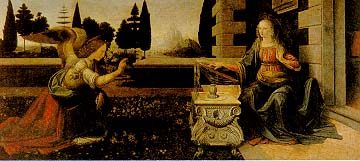
Leonard da Vinci's "Annunciation" is now on exhibit in the Tokyo National Museum. Taking a good look at it, I realized how it is not only an excellent manifestation of the artistry of painting, but also a fine expression of human intellect.
There is this misconception that the natural media for academism are papers and essays. A piece of art, on the other hand, is often considered as something separate from these expressions of human wisdom, something in coherence with the primordial emotions and urges that are rather curbed in the pursuit of excellence in academism.
But such a view is clearly ill-conceived, and Leonard's work is a fine proof in residence. For a starter, in this painting everything looks alive, vibrant, not only Mary and Gabriel, and the flowers at the foot of the angel, the trees in distance, all those which are considered alive in the conventional world view, but also the stone wall, the mountain, the clouds, the air, and even the Bible. Such a spiritual timbre captured on panel can only come from a deep understanding of the coherences and differentiations between life and materials, the mind and matter, space and time, the essence of all living things, and the relation between man and god.
In short, "Annunciation" is an exquisite expression of a deep thinking intellectual that was Leonard, just as Origin of Species was the culmination of Charles Darwin's intellectual endeavors over many years. Leonard was in his early twenties when he did this "thesis in oil"
There is this misconception that the natural media for academism are papers and essays. A piece of art, on the other hand, is often considered as something separate from these expressions of human wisdom, something in coherence with the primordial emotions and urges that are rather curbed in the pursuit of excellence in academism.
But such a view is clearly ill-conceived, and Leonard's work is a fine proof in residence. For a starter, in this painting everything looks alive, vibrant, not only Mary and Gabriel, and the flowers at the foot of the angel, the trees in distance, all those which are considered alive in the conventional world view, but also the stone wall, the mountain, the clouds, the air, and even the Bible. Such a spiritual timbre captured on panel can only come from a deep understanding of the coherences and differentiations between life and materials, the mind and matter, space and time, the essence of all living things, and the relation between man and god.
In short, "Annunciation" is an exquisite expression of a deep thinking intellectual that was Leonard, just as Origin of Species was the culmination of Charles Darwin's intellectual endeavors over many years. Leonard was in his early twenties when he did this "thesis in oil"
Monday, April 16, 2007
The tuna night
In a warm night, when the wind is gently breezing around my body, there is one memory that comes back to me again and again. It is about two university undergraduates lying on the banks of the Sumida River in downtown Tokyo at dusk, just like a pair of tuna fish in the Tsukiji fish market. One is Ken Shiotani, the fat (or in other words, "gravitationally challenged") philosopher of temporality and other enigmas. The other is I, his best friend at that time and since, bubbling about everything like a boiling kettle.
In those days we hang out together and talked about difficult things in general, so there was nothing unusual about our killing time on the riverbank. Still, that night stands out as a hallmark in our youthful investigations. We had a can of beer each, with very casual clothing. We may have looked like two homeless people, or aspiring candidates thereof. There were a number of couples strolling along the river. Night was falling, and walking with your loved one was the only sensible thing to do. We talked about science and philosophy instead. We were clearly the odd ones out.
The couples, seeing that there were two shabbily dressed blokes with beer cans, apparently talking nonsense, chose to do what was clearly sensible. Each of them unfailingly made a large detour along the bank, avoiding us in a great circular trajectory, going back to their normal strolling behavior once they were safely distant from the two strange persona non grata.
I don't know why that night stands out so vividly in my memory. Maybe it is a symbol of our youthful misery, or perhaps it is rather that of a sublime glory in deprivation. In any case, I do cherish the remembrance, wishing that I could go back to that very night as an ignorant youth.
Theoretically, we could restage our "tuna night on the bank" anytime even at a mature age. Only stupid social customs and mannerisms prevent us from enjoying the fruits of poignant follies. Maybe I should get a can of beer and call up Shiotani and head for the Sumida River at this very moment.
In those days we hang out together and talked about difficult things in general, so there was nothing unusual about our killing time on the riverbank. Still, that night stands out as a hallmark in our youthful investigations. We had a can of beer each, with very casual clothing. We may have looked like two homeless people, or aspiring candidates thereof. There were a number of couples strolling along the river. Night was falling, and walking with your loved one was the only sensible thing to do. We talked about science and philosophy instead. We were clearly the odd ones out.
The couples, seeing that there were two shabbily dressed blokes with beer cans, apparently talking nonsense, chose to do what was clearly sensible. Each of them unfailingly made a large detour along the bank, avoiding us in a great circular trajectory, going back to their normal strolling behavior once they were safely distant from the two strange persona non grata.
I don't know why that night stands out so vividly in my memory. Maybe it is a symbol of our youthful misery, or perhaps it is rather that of a sublime glory in deprivation. In any case, I do cherish the remembrance, wishing that I could go back to that very night as an ignorant youth.
Theoretically, we could restage our "tuna night on the bank" anytime even at a mature age. Only stupid social customs and mannerisms prevent us from enjoying the fruits of poignant follies. Maybe I should get a can of beer and call up Shiotani and head for the Sumida River at this very moment.
Sunday, April 15, 2007
Forgetting
As one gets along with time in life, many thing accumulate in the brain. You cannot recall them explicitly. But it is all there. Therefrom come life's many blessings, like the growing personality and the nostalgic memories. On the other hand, like a wine that has gone bad due to an ill conceived maturation treatment, traces of the past can kill the vital freshness within the self.
Therefore it is sometimes good to forget. To feel as if one was born today, where everything in the world is fresh, envigorating, and full of surprises. To feel again that everything is possible, where you are provided with potentially infinite future time. You felt like that in your childhood. There is no reason why you cannot feel the same, no matter how old you are. It is just a matter of tricking your brain into an exquisite cocktail of context-formation, pretending, and believing in the potential of the universal elan vital. Everything is bottomless, and therefore infinite.
Therefore it is sometimes good to forget. To feel as if one was born today, where everything in the world is fresh, envigorating, and full of surprises. To feel again that everything is possible, where you are provided with potentially infinite future time. You felt like that in your childhood. There is no reason why you cannot feel the same, no matter how old you are. It is just a matter of tricking your brain into an exquisite cocktail of context-formation, pretending, and believing in the potential of the universal elan vital. Everything is bottomless, and therefore infinite.
Saturday, April 14, 2007
From E. Coli to Chestnut Tigers
This saturday morning, I chatted with Dr. Ueda of Riken about his research on biological clockes, in the editorial office of Nikkei Science. While we strolled in the corridor of interesting facts and ponderings, he mentioned a ongoing research in which the investigator cultured E. Coli for 20 years. Apparently these small chaps "adapted" to the new environment. Wild types of E. Coli, when put into a new environment, do not start dividing until after some delay period, consistent with the idea that the primitive biological forms are "probing" the environment to see if it is fit. The cultured E. Coli, on the other hand, somehow learn to start reproduction "straight away". Presumably they have figured out that the environment they are in is fit for proliferating, and no initial probings are necessary. The underlying molecular mechanisms behind this adaptation are still to be elucidated.
That story somehow reminded me of the butterfly Chestnut Tiger (Parantica sita). This is a beautiful but poisonous species. The birds, after learning that these creatures with inviting appearances actually taste nastily, do not bother them. Chestnut Tigers therefore fly very slowly, with a certain air of elegance, as if they know they wouldn't be chased by birds. When an ignorant enemy tries to attack them, however, for example by the small boy that was I thiry-something years ago, Chestnut Tigers would suddenly shoot up into the high air.
When, however, I waved my hands towards the artificicially cultivated Chestnut Tigers in the Giant Glass Insect Dome of Tama zoo, they could be hardly less perturbated. They have somehow learned that they were now enclosed in a space with a ceiling, and that shooting up into the air did not make any sense. They just kept flying in a slow-motion elegance, after some irritated movement induced by my hands.
The adaptabilities of biological systems, from E. Coli to Chestnut Tigers, never ceases to amaze me. The wonder is how the system and molecules work together to make it happen.
That story somehow reminded me of the butterfly Chestnut Tiger (Parantica sita). This is a beautiful but poisonous species. The birds, after learning that these creatures with inviting appearances actually taste nastily, do not bother them. Chestnut Tigers therefore fly very slowly, with a certain air of elegance, as if they know they wouldn't be chased by birds. When an ignorant enemy tries to attack them, however, for example by the small boy that was I thiry-something years ago, Chestnut Tigers would suddenly shoot up into the high air.
When, however, I waved my hands towards the artificicially cultivated Chestnut Tigers in the Giant Glass Insect Dome of Tama zoo, they could be hardly less perturbated. They have somehow learned that they were now enclosed in a space with a ceiling, and that shooting up into the air did not make any sense. They just kept flying in a slow-motion elegance, after some irritated movement induced by my hands.
The adaptabilities of biological systems, from E. Coli to Chestnut Tigers, never ceases to amaze me. The wonder is how the system and molecules work together to make it happen.
Wednesday, April 11, 2007
Creative Concessions
Recently, I met with the architect Kengo Kuma for intervew on the weekly "The Professionals" program that I am hosting for NHK with Ms. Miki Sumiyoshi. It was not the first time that I met with this famous architect. However, it was the first proper and long chat, lasting for more than 4 hours, which unfortunately would be compressed into 15 minutes in the actual broadcast.
Kengo's architectural philosophy is that of "creative concessions". He criticizes the modern approach of steel and concrete for the very freedom that these materials have given the architects. When you use alternative building materials such as wood, there are numerous restrictions to which you are obliged to make concessions to. True creativity arises from these restrictions and concessions, Kengo says.
When asked what kind of architecture he would build if there was no restriction arising from the environment, materials, or budget, Kengo answered after some moments of pondering that he would discover a restriction somehow even in that case. I realized why Kengo is considered as one of the key architects in the 21st century.
Kengo's architectural philosophy is that of "creative concessions". He criticizes the modern approach of steel and concrete for the very freedom that these materials have given the architects. When you use alternative building materials such as wood, there are numerous restrictions to which you are obliged to make concessions to. True creativity arises from these restrictions and concessions, Kengo says.
When asked what kind of architecture he would build if there was no restriction arising from the environment, materials, or budget, Kengo answered after some moments of pondering that he would discover a restriction somehow even in that case. I realized why Kengo is considered as one of the key architects in the 21st century.
Monday, April 09, 2007
Whiskey time
We are supposedly living in a "dog year". But certain things take longer time. Take the maturation of whiskey, for example. If you would like to make a fine whiskey, you need to allow for at least ~ 10 years of maturation time. In order to stage a good aging of the liquid, a fine oak barrel is an absolute necessity. An oak tree takes a hundred years to grow to a size appropriate for use as a barrel. Peat, traditionally used in Scotland to give that peculiar flavor, is an accumulation of partially decayed vegetation matter which takes ages to form. Whiskey time, in contrast to the dog year, is a symbol of painfully slow processions of things.
When it comes to the maturation of a personality, it takes all of life to materialize. The synaptic plasticity in the brain takes a few weeks to be molecularly completed. We learn very slowly as a molecular machine, but the accumulation hopefully would lead to a non-trivial transformation of character.
Even the computer, when deciphered in terms of the atoms that make it up, lives in a whisky time. The heavy atoms can only be transformed through cycles of galaxies being formed and then perished. The dog year can only flourish on top of the atomic whiskey time.
We sometimes become too enthusiastic at the cost of ignoring the whole picture. Information technology has not freed us from the curses and blessings of the cosmic whiskey time.
When it comes to the maturation of a personality, it takes all of life to materialize. The synaptic plasticity in the brain takes a few weeks to be molecularly completed. We learn very slowly as a molecular machine, but the accumulation hopefully would lead to a non-trivial transformation of character.
Even the computer, when deciphered in terms of the atoms that make it up, lives in a whisky time. The heavy atoms can only be transformed through cycles of galaxies being formed and then perished. The dog year can only flourish on top of the atomic whiskey time.
We sometimes become too enthusiastic at the cost of ignoring the whole picture. Information technology has not freed us from the curses and blessings of the cosmic whiskey time.
Sunday, April 08, 2007
When we look up to the cherry blossoms
We love the cherry blossoms in spring because of their short existence on earth. If these flowery manifestations of the power of life stayed for months, our enthusiasms would be greatly diminished.
When you think about it, everything in the universe is in permanent motion. A tiny stone on your desk, which, after being forced out of the earth and transported and gradually destroyed and frictioned by the workings of water, seems finally to be at rest. However, inside the cool and still image of the stone surface, electrons are swirling around the nucleus in an eternal zitterbewegung, the positrons and neutrons and the quarks that make up these particles are in constant motion, even being destroyed and created from nothing in the poignant void of space-time.
Life is based on the perpetual motion of things, and therefore changes and deaths are inevitable. When we look up to the cherry blossoms, and witness their rapid demise from the prime of beauty, what is happening is nothing more than a result of the universal passage of time which affect life and non-life in the cosmos alike. The fact that we are affected and feel a sweet pain in our soul is ultimately an enigma, albeit so natural from the point of life's common senses, as nothing is changing in terms of the fundamental ways of things when it happens.
When you think about it, everything in the universe is in permanent motion. A tiny stone on your desk, which, after being forced out of the earth and transported and gradually destroyed and frictioned by the workings of water, seems finally to be at rest. However, inside the cool and still image of the stone surface, electrons are swirling around the nucleus in an eternal zitterbewegung, the positrons and neutrons and the quarks that make up these particles are in constant motion, even being destroyed and created from nothing in the poignant void of space-time.
Life is based on the perpetual motion of things, and therefore changes and deaths are inevitable. When we look up to the cherry blossoms, and witness their rapid demise from the prime of beauty, what is happening is nothing more than a result of the universal passage of time which affect life and non-life in the cosmos alike. The fact that we are affected and feel a sweet pain in our soul is ultimately an enigma, albeit so natural from the point of life's common senses, as nothing is changing in terms of the fundamental ways of things when it happens.
Saturday, March 10, 2007
Homeostasis
Homeostasis, the maintenance of the status quo, is an important aspect of all biological processes. Evolution deals with a long time scale, so that it appears as if everything is possible, supposedly depending on the random mutations and natural selections. Development of an organism, on the other hand, happens in a much shorter time scale. When a fertilized egg develops into a multi-cellular life-form, there is not much new information being generated through an interaction with the environment. So that we need to consider the multi-cellular development as an instance of homeostasis.
The concept of homeostasis is accompanied by (some) invariant parameters. Development on the surface appears to be a generation of new order de nuvo, but in actuality it must be sustained by the invariance of some structural properties, turning the implicates into the explicits. Learning, accompanied and resulting in personality changes, can too be regarded as an instance of this generalized concept of homeostasis.
The concept of homeostasis is accompanied by (some) invariant parameters. Development on the surface appears to be a generation of new order de nuvo, but in actuality it must be sustained by the invariance of some structural properties, turning the implicates into the explicits. Learning, accompanied and resulting in personality changes, can too be regarded as an instance of this generalized concept of homeostasis.
Subscribe to:
Comments (Atom)