Saturday, August 06, 2005

Dialogue with Rei Naito

I had a dialogue with the artist Rei Naito in the Bungeishunju building in Kioicho. The diaglogue will be published in "Bungakukai" (Literature World), the most respected literary monthly in Japan.
Rei Naito's artworks are going to be featured on the cover from the October issue of Bungakukai. The dialogue was intended to be a kick-off introduction of the artist to the readership of Bungakukai.
Rei Naito, a good friend of mine, is known for her exquisite arrangement of small things in a carefully prepared space. She believes, she said, that if you sincerely attend to one small thing in the world around you, that thing will reward you with a deep presence of beauty which makes you thankful for the very existence of the world as it is here and now. She has always lived with that particular sense of the appreciation of small things that be, without any specific reference to the already established religions or systems of thought. Her works are thankful depiction of the blessings that are apparent around us, sometimes buried in the busy goings of a modern world, but present all the same at any time. Like any great pieces of art Rei Naito's work makes us aware of what we've always known and unconsciously carried within us, but became oblivious in the busy daily execution of practical things.
After the dialogue we had a merry time in the "Pizza Mia" Italian restaurant near Bungeishuju building. The editor-in-chief Shigeki Okawa and Ms. Naoko Yamashita, who has edited my "Literature in the brain" essays in Bungakukai, were also present. The restaurant owner, the chef, and the waiter are all Italian. For strange and unknown reasons they do not speak a word of Japanese although the restaurant is situated in the heart of Tokyo and almost all the customers from local. The whole situation gave you a sense of traveling abroad, which was a nice little piece of midsummer's dream.


Rei Naito's "Pillows for the Dead" from the installation "Being Called"

Friday, August 05, 2005

My first download at the Apple iTunes Music Store

The long awaited Apple iTunes Music store opened here in Japan at last! I checked the site from my iTunes the first thing in the morning. They say there are roughly a million pieces on offer. I searched for some of my nostalgic numbers but could not find them. Maybe a million is not large enough to encompass the music universe that we all live in. The memorable first download was "Tounasuya- seidan" by the great Rakugo artist Kokontei Shinsho. Rakugo is the traditional Japanese art of comedy story-telling. A Rakugoka (Rakugo artist) sits on the floor to tell the comic story, so it is not a stand-up comedy, it is rather a sit-down comedy. "Tounasuya-seidan" is one of the most beloved masterpieces from the great Shinsho, about a delinquent son who repents and becomes a true man after some comic and yet heart-warming incidents in the ancient Tokyo of the Edo era (1603-1867).
I am happy to get this piece. Now I can listen to it on the Tokyo subway on my way to the lab.


My first download from the Apple iTunes Music Store was "Tounasuya-seidan" by Kokontei Shinsho, the famed Rakugo artist.

Thursday, August 04, 2005

The taste of Guinness

I went to Dublin only once. I attended a conference organized by Tony Veale of the University College Dublin. When I and Yoshihide Tamori entered a pub on arrival, we were surprised to find ourselves in a dark room, with people's faces candle-lit in the many corners defined by chairs and tables. It was midday. The taste of our first genuine Guinness was quite impressive. In particular, the smooth and milky foam on top of the dark liquid really made one happy.
I have had some glasses of Guinness elsewhere, but never encountered that particular taste. So I concluded at that time that Guinness does not travel well. I thought that in order to taste the real one, you simply got to travel to Dublin.
Time passed, and modern technology made it possible to taste real Guinness on a daily basis here in Tokyo. I am not talking about the rapidly increasing Irish pubs here, I am referring to the canned beer on sale in the convenience stores. In the can, they have installed a special device called "floating widget", which produces the smooth creamy head that is the hallmark of Guinness in the Dublin pub. It is quite impressive.
So I don't have to travel to Dublin. I can just hop into one of the Tokyo convenience stores and by a can of Guinness. Then I think of the good times that I had we Tony Veale in Dublin, the musicality of the language, and feel a bit nostalgic.


The canned Guinness being sold in Tokyo

Wednesday, August 03, 2005

Piet Hut and the QRIO

Piet Hut came to visit our lab for the second time. Dr. Fumihide Tanaka of Sony Intelligence Dynamics Laboratories was also present. We discussed about Fumihide's experiment on robot-infant interaction going on in a San Diego nursery school. There are already some interesting aspects emerging from this ongoing research. Piet made some keen observations.
Shinichi Nozawa of Waseda University, and Nobuo Ishikawa of Tokyo Institute of Technology also participated in the discussion. They are most likely to join our lab starting next April.
After the serious talk, we continued our exchange of thoughts in a more relaxed environment of "Asari", a nice Izakaya in Gotanda area frequented by us. After some mugs of beer and glasses of sake, the border between robots and humans, or between sobriety and merriment, seemed to become even fuzzier.
After the merry but serious "symposium", Shinichi Nozawa and Takayasu Sekine walked Piet back to the hotel.


The Robot in question. Sony's Qrio

Tuesday, August 02, 2005

How science makes the feeling deeper for Penguins

The French film "March of the Penguins" directed by Luc Jacquet is being shown in Japan. I went to the preview show. Although the effort of the crew to shoot the breathtaking scenes through the harsh winter of the Antarctica is laudable, the film, in my perspective, was seriously flawed in two essential respects. The oversimplified impersonation of the emperor penguins and the cheap "poetic" narrative. These flaws made the wonderful scenes much less enjoyable than otherwise.
People sometimes don't realize how an objective and scientific understanding promotes a deeper appreciation of life, rather than dissecting it out of it vital force. Science is sometimes depicted as cold and impartial, but the most profound perception of what life involves actually comes from scientific understanding.
In these respects, David Attenborough's "Life In the Freezer" produced by BBC is far superior in depicting the trials of life faced by these magnificent creatures on the white earth. In this much-praised film, Attenborough describes the life of penguins in a dry, matter-of-fact way. The Penguins are not there to entertain us, they are there to survive, human sentimentalism having nothing to do with the daily overcoming of their trials.
The march of penguins was cheap poetry. Life in the freezer showed much deeper poetry, made possible only through a rigorous and objective appreciation of the life of a creature far removed from us like a distant star.


Much deeper poetry. David Attenborough's Life in the Freezer.

Monday, August 01, 2005

August!

When I was a kid, August was a special month. You had one month long vacation, in which you would go to places. Sometimes I would climb mountains with my parents. One year we went to Meshimori-yama in Nagano. I still remember the green slope, the gradual ascent to the top, and then the panoramic view. In those days you would follow somebody else's initiative, because you were small. There is a particular subjective feeling to following other's initiative. That is the hallmark of childhood. I sometimes miss the feeling. Nowadays I need to generate my own initiative and I do it in a matter-of-fact way. The long summer vacations are gone, and August is not a special month any more.


View of the Meshimori-yama mountain in Nagano.

Sunday, July 31, 2005

Making "musical" out of the "Ring"

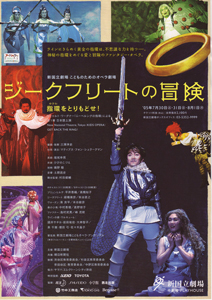
As a perfect Wagnerite I could not miss the New National Theater (in Tokyo) production of "Get back the Ring!". It was termed a "Kids Opera", so I expected some changes from the original work, Der Ring des Nibelungen. Actually the changes were substantial. What emerged from a substantial re-interpretation and arrangements from the original work was a "musical", with Brunnhilde portrayed as the beautiful princess and Siegfried as a suitor who would do bold things to win her love. Wotan is the King, who reluctantly, and then wholeheartedly, gives his daughter and the kingdom to the young hero.
All the music was from the original score, but the whole impression was that of a "musical", rather than a "music drama". I realized that the difference between a musical and an opera is not only in the music but also in the (con)text.
The musical format is well accepted in today's highly commercialism-oriented society, but it does not, in its prevalent style, really have a power to make one stop and think about deep issues such as death, life, and love.
The "musical" presented by the New National Theater probably left the kids and their well-meaning parents happy, but I wonder whether the audience were touched in a real sense either directly or indirectly by the greatness of the original work. In the original music drama, a man has to forsake love in order to win political power. There's incest and murder. One is bound by his own commitment in the past, and the space for free will is gradually diminished until one is led to the conclusion that the only way out is total self-denial. Then, when all the entangled elements appear to be just impossible to handle, the redemption by love gives a deeply satisfactory ending to the whole saga.
Although it is certainly a high order to depict all this in a "Kids Opera", I certainly think that it was possible to depict some elements, something that would inflict a benevolent "scar" on a child's heart. Every great work of art leaves a scar on one's mind, and the appreciation starts with the healing process.
"Get back the Ring!" failed to leave a scar, at least on this listener's heart. It was a great opportunity lost, for the kids in the theater and the well-meaning art directors of the New National Theater.

http://www.nntt.jac.go.jp/english/season/s266e/s266e.html


Poster advertising "Get Back the Ring!"

Saturday, July 30, 2005

Piet Hut's hightlights.

Piet Hut's hightlights.

The famed astrophysicist Piet Hut, who recently came to visit me, has a log of the highlights of his life. He was kind enough to put a pointer on his blog. Here I put my pointer to Piet, so that people can surf in a closed loop if they wish.
http://www.ids.ias.edu/~piet/act/high.html


Prof. Piet Hut of the Institute of Advanced Study in Princeton.

James Joyce's delirium.

I used to have a very beautiful copy of "Dubliners" by James Joyce. I purchased it in a second-hand bookshop in Cambridge, U.K., where I was studying as a postdoctoral fellow. The book came with lots of photos of the old Dublin, possibly from the time of Joyce. I was very fond of the book, and would read excerpts in my bed before I go to sleep. I somehow lost the copy and my favorite pictures are gone.
I think the first encounter with Joyce was The Boarding House. It was given as a reader for the summer vacation at senior high. I still remember one word; "delirium". It was in the phrase "They used to kiss. He remembered well her eyes, the touch of her hand and his delirium...."
The novel goes on to say "but delirium passes". In my case, somehow the delirium stuck with me, and I still read Dubliners from time to time. "Dubliners" for me represents the best in English prose.
I have not yet challenged the more intimidating pieces of Joyce. They should be good, coming from such a genius.

Friday, July 29, 2005

Earthquakes real and imagined.

We sometimes have earthquakes in Japan. In Tokyo, we have not had a really bad one in my personal history since birth. They say we may have the real thing at any time. Like any great earthquake centers in the world, such as California or Italy, it may strike today or tomorrow, but there is nothing you really can do about it.
Recently we've had some mildly bad earthquakes. There was no serious casualty, though. Yesterday there was yet another one. When I am in the middle of an earthquake, like recently, I sometimes wonder why I am not feeling that scared. Then I realize I have experienced worse ones in my dream.
From my childhood, probably because I grew up in an earthquake-rich region, I sometimes had earthquake dreams. In some of them, I would be in a building, and the building would swing to-and-fro, really slowly and with large amplitude. These imagined earthquake experiences left me bewildered and awed, like the very foundation of the world in which I exist is shuddered.
My dreams perhaps prepared myself for the really big ones, imagined or otherwise, so that the impression that actual earthquakes have on me is somehow diminished. In real life I have never experienced such an awful earthquake, swinging to-and-fro. But I surely have some idea what it would be like when it occurs.

Thursday, July 28, 2005

Surely you're joking, Mr. Feynman.

When I was at graduate school, I read this book 10 times. It was that good. Several years have passed since I last read it, but I still remember some of the funny stuff.
What is great about Richard Feynman is his refusal to take anything too seriously. Rather, he refused to take anything too seriously because he was damn serious. When you think of it, only people who are not really serious appear to be serious. Seriousness in appearance is different from seriousness in essence.
My girl friend at that time used to do private tutoring for students who wanted to do well in university entrance exams. She used to make the student read excerpts from Surely you're joking, Mr. Feynman. She said the pupil liked the chapter on how to become friendly with women. Now, that was funny, with Richard Feynman trying out the instructions of the bar master, almost failing, but then sticking to his gun, and finally getting the reward. If you scratch your head and don't know what it is all about as you read this blog, then you should definitely read this book. I assure you that you would be laughing like mad before long.