I was not well. I had a cold, and yet kept drinking with my friends until the small hours. The folly had a destructive effect the next day. I lay in the sofa, sighing. At nightfall I went to bed and had a serious sleep. Then the dream took hold of me.
I was in London. I found myself in front of a railway station. I sensed that it was in the suburbs, somewhere in the northeast. The time of the day was ambiguous. It could be late afternoon, or early morning. In any case, the sunbeam was shifting, and I needed to get to central London. I wondered if I could walk the distance. After some thought, I judged it better to take the train to King's Cross.
As I entered the station, somebody called my name. I looked back to find an old acquaintance. I was trying to converse with him, but the train was about to leave. I started to run. He seemed to follow me, and got on the same train.
The train was crowded. I stood next to the window, and looked out. There was a park passing by, and then my view was flying out into the sky. I could examine the London area from the vantage point of high above. I would look for the greens, and fly through the air to be immersed in the forage.
When I came back from the reverie, I realized that my friend was gone. I did not know where I was. Then I realized that I passed the King's Cross station already. It was too late to repent. I could sense that there was music. "Calling you" by Natalie Cole. I awoke, and realized that it was coming from the T.V. , which was left on as I went to sleep. I realized that I was still in Tokyo, in my room. I had to get up to do some work.
After a few minutes, I was in a practical mode, drinking my coffee, nibbling chocolate. Soon I would be working like a diligent robot, forgetful of distractions.
And yet the London dream had a strange effect on my spirit. I taste the aftermath still. After all, dreaming is another form of experience.
Monday, November 28, 2005

Saturday, November 19, 2005
Abstracts for SFN 2005
Abstracts presented by our research group at the
Society for Neuroscience annual meeting 2005
(Washington D.C., U.S.A.)
http://apu.sfn.org/am2005/
Reactivation and consolidation in long-term memory
Fumiko Tanabe and Ken Mogi.
abstract
Role of meta-cognition in decision making under uncertain conditions
Fumihiko Taya and Ken Mogi
abstract
Robust perception of phonemes in complex stimulus conditions.
Kei Omata and Ken Mogi
abstract
Spontaneous ongoing dynamics and plasticity in neural networks.
Toru Yanagawa and Ken Mogi
abstract
Perception of objects in the pantomime effect and real pantomimes
Q. Zhang and K. Mogi
abstract
Society for Neuroscience annual meeting 2005
(Washington D.C., U.S.A.)
http://apu.sfn.org/am2005/
Reactivation and consolidation in long-term memory
Fumiko Tanabe and Ken Mogi.
abstract
Role of meta-cognition in decision making under uncertain conditions
Fumihiko Taya and Ken Mogi
abstract
Robust perception of phonemes in complex stimulus conditions.
Kei Omata and Ken Mogi
abstract
Spontaneous ongoing dynamics and plasticity in neural networks.
Toru Yanagawa and Ken Mogi
abstract
Perception of objects in the pantomime effect and real pantomimes
Q. Zhang and K. Mogi
abstract
Tuesday, November 01, 2005
ICONIP papers
Papers presented at ICONIP 2005
(Taipei, Oct 30 to Nov 2 2005)
http://cnn.cn.nctu.edu.tw/iconip2005/
Omata, K. and Mogi, K.
Robust phoneme perception in complex stimulus conditions.
Proceedings of ICONIP 2005
pdf file
Sekine, T. and Mogi, K.
Effect of hand posture on tactile perception in crossed fingers.
Proceedings of ICONIP 2005
pdf file
Zhang, Q. and Mogi, K.
REPRESENTATION OF 3-D VOLUMETRIC OBJECT AND SUBJECTIVE CONTOUR IN HUMAN BRAIN
Proceedings of ICONIP 2005
pdf file
(Taipei, Oct 30 to Nov 2 2005)
http://cnn.cn.nctu.edu.tw/iconip2005/
Omata, K. and Mogi, K.
Robust phoneme perception in complex stimulus conditions.
Proceedings of ICONIP 2005
pdf file
Sekine, T. and Mogi, K.
Effect of hand posture on tactile perception in crossed fingers.
Proceedings of ICONIP 2005
pdf file
Zhang, Q. and Mogi, K.
REPRESENTATION OF 3-D VOLUMETRIC OBJECT AND SUBJECTIVE CONTOUR IN HUMAN BRAIN
Proceedings of ICONIP 2005
pdf file
Sunday, October 30, 2005
My life as a Neanderthal.
The other day I went to a studio in central Tokyo and had my photos taken. Mr. Yamada of Bungeishunju publishing was with me. These photos were for the cover of my new book on literature ("The Descent of Qualia", to be published in December from Bungeishunju). The photographer used HUGE polaroid sheets. When the pictures came out, he stuck them on the studio wall. My life as a Neanderthal came into full view gradually.
I never thought of myself as a savage person, but these photos did depict me as a primitive man. Maybe there is something primordial within me.
On 20th October 2005, I turned 43. You could say that at may age it is good to be primitive and savage. For a start, I made a vow to go for jogging at least once a week. Let's see if I can manage that. It is difficult to live up to the reputation of a Neanderthal. All the more so in the hectic Tokyo, although where I live, there are some nice forests still left. What a relief for the Neanderthal.

I never thought of myself as a savage person, but these photos did depict me as a primitive man. Maybe there is something primordial within me.
On 20th October 2005, I turned 43. You could say that at may age it is good to be primitive and savage. For a start, I made a vow to go for jogging at least once a week. Let's see if I can manage that. It is difficult to live up to the reputation of a Neanderthal. All the more so in the hectic Tokyo, although where I live, there are some nice forests still left. What a relief for the Neanderthal.
Tuesday, October 11, 2005
For the love of pampas grass
Autumn is probably the best season of the year for me. I particularly love the sight of the Japanese pampas grass swaying to and flo in the sunshine. The pity is I seldom have the time to take a good look at them for a long time. I am sure I can spend hours admiring the scene. Most often it so happens that I pass a spread of pampas grass in the car, on the train, and take just a brief glimpse of it, leaving my longing behind. Maybe they would be tossing the leftover particles of my soul in the blowing wind.
The pampas grass season is a long one. From late September until well into December, whenever you travel, you are sure to capture a sight of these beautiful plants. Japan in autumn becomes a pampas grass land, at least in my fond imagination.
One of these days I would walk though a pampas grass field and take in the autumn air deep into my lung, and thank for the occasional bliss that this frequently prosaic earth brings to us.

The pampas grass season is a long one. From late September until well into December, whenever you travel, you are sure to capture a sight of these beautiful plants. Japan in autumn becomes a pampas grass land, at least in my fond imagination.
One of these days I would walk though a pampas grass field and take in the autumn air deep into my lung, and thank for the occasional bliss that this frequently prosaic earth brings to us.
Tuesday, August 16, 2005
Transparent runner on the second base!
Many people have said various things about video games. Although there are many pros and cons, one thing is strangely missing from the current video games. A huge deficit of functionality, seeded in the game and then required for the human to conform, is apparent if you once notice it. Let's call that functionality "meta-cognition for rule-making" What does the meta-cognition signify here? Let me explain.
When I was a kid, I used to play the baseball a lot. The reality of suburban Japan at that time was that you wouldn't play in a proper baseball field. You had to make do with what vacant space there happened to be, either in the small playgrounds or chunks of land being vacant temporarily before the construction began. You sometimes chose to play with "triangular base", instead of the regular "diamond". You discussed with your friends whether there should be a catcher. The "strike" and "ball" counts were also optional. Stealing the base was seldom allowed. All these things had to be negotiated before the actual game started. You also had to decide what handicaps needed to be allowed for the weak and unskilled. All these negotiations were aimed, with the benefit of hindsight, at making the game the most enjoyable possible. You didn't simply play the game, you had to make all these rules. That's what I call meta-cognition. Standing out of the gaming itself, and observing it with the eye of an outsider.
There were even times when you had to resort to exotic rules. Like when there were only insufficient number of players, and you had to declare that a "transparent runner" was on the base. That happened when a player on the base had to be the next batter. He would then shout "transparent runner on the second base", and run to the batter's box.
All these meta-cognitive functions are lacking in today's video games. You don't make the rules, the computers make the rules. You simply try to maximize your performance under the dictatorship of the computer. Thus a whole area of human capabilities is forced to be dormant.
When you observe small kids playing, you would often notice that they are making their own rules. Like granting handicaps for the small and weak. The meta-cognition comes so naturally to children. It is a grand challenge for makers of video games to install that functionality. It is certainly a tall order.

A triangular base game. Everything so free and chaotic. You have to make your own rules.
When I was a kid, I used to play the baseball a lot. The reality of suburban Japan at that time was that you wouldn't play in a proper baseball field. You had to make do with what vacant space there happened to be, either in the small playgrounds or chunks of land being vacant temporarily before the construction began. You sometimes chose to play with "triangular base", instead of the regular "diamond". You discussed with your friends whether there should be a catcher. The "strike" and "ball" counts were also optional. Stealing the base was seldom allowed. All these things had to be negotiated before the actual game started. You also had to decide what handicaps needed to be allowed for the weak and unskilled. All these negotiations were aimed, with the benefit of hindsight, at making the game the most enjoyable possible. You didn't simply play the game, you had to make all these rules. That's what I call meta-cognition. Standing out of the gaming itself, and observing it with the eye of an outsider.
There were even times when you had to resort to exotic rules. Like when there were only insufficient number of players, and you had to declare that a "transparent runner" was on the base. That happened when a player on the base had to be the next batter. He would then shout "transparent runner on the second base", and run to the batter's box.
All these meta-cognitive functions are lacking in today's video games. You don't make the rules, the computers make the rules. You simply try to maximize your performance under the dictatorship of the computer. Thus a whole area of human capabilities is forced to be dormant.
When you observe small kids playing, you would often notice that they are making their own rules. Like granting handicaps for the small and weak. The meta-cognition comes so naturally to children. It is a grand challenge for makers of video games to install that functionality. It is certainly a tall order.
A triangular base game. Everything so free and chaotic. You have to make your own rules.
Friday, August 12, 2005
"To Sir Georg Solti"
It was always a treat to go to the opera at the Covent Garden during the two years I stayed in the U.K. At one time, my best philosopher friend, Ken Shiotani, came to visit me with his wife. We went down from Cambridge to London on the train. We went to see the opera at the Covent Garden. I do not quite recall what we saw. In any case, the most memorable moment visited us outside the theatre, not inside it. Beside the theatre, there was a black, luxury car. As we passed by, we happened to glance inside. On the seat next to the driver, there was an envelope. "To Sir Georg Solti", the letters on the surface could be read.
At that time, the great conductor was still with us, and he was apparently doing something in the house, although he was not conducting on that evening. The envelope brought a sense of intimacy with the man, and although it was of course an illusion, that was a wonderful one even so. I and my philosopher friend later discussed that it was the highlight of the whole evening.

Sir Georg Solti 1912-1917.
At that time, the great conductor was still with us, and he was apparently doing something in the house, although he was not conducting on that evening. The envelope brought a sense of intimacy with the man, and although it was of course an illusion, that was a wonderful one even so. I and my philosopher friend later discussed that it was the highlight of the whole evening.
Sir Georg Solti 1912-1917.
Thursday, August 11, 2005
In the middle of rice fields.
I went to the municipality of Inashiki to give a public lecture on brain and mind. In Japan, railways are big. Although Inashiki is in the Kanto plane (in which Tokyo is situated), it is at least one-hour drive from any of the railway stations around. That means, in the railway-oriented Japanese psyche, Inashiki is very very far away. Perhaps these areas are one of the best-kept secrets for an incidental traveler. I enjoyed being driven by the organizers through the endless rice fields.
The great extension of plain land in summer means that there is a risk of thunder and lightening. We had a jolly loud one during my lecture. The air conditioning of the auditorium was malfunctioning, due to a heavy thunderstorm a few days earlier, I learned. The audiences were mainly teachers of elementary and junior high schools. The questions and discussions were enjoyable, with many insights gained from a direct interaction with the modern children, despite the heat.
It is always heartening to share thoughts with school teachers. You are reminded of your own past, when you were a small kid, being given many things by the well-meaning teachers, and then disappearing from their sight without saying enough words of thanks. Many essential interactions in this world are unidirectional. Teacher-pupil relations are representative of that truth in life.

A road in the middle of rice fields--a typical rural landscape in Japan.
The great extension of plain land in summer means that there is a risk of thunder and lightening. We had a jolly loud one during my lecture. The air conditioning of the auditorium was malfunctioning, due to a heavy thunderstorm a few days earlier, I learned. The audiences were mainly teachers of elementary and junior high schools. The questions and discussions were enjoyable, with many insights gained from a direct interaction with the modern children, despite the heat.
It is always heartening to share thoughts with school teachers. You are reminded of your own past, when you were a small kid, being given many things by the well-meaning teachers, and then disappearing from their sight without saying enough words of thanks. Many essential interactions in this world are unidirectional. Teacher-pupil relations are representative of that truth in life.
A road in the middle of rice fields--a typical rural landscape in Japan.
Tuesday, August 09, 2005
Japan's postal reform is halted.
National politics is only the nation's residents' concern, so it may not be interesting for people outside Japan but yesterday was a historic day in Japanese politics. The postal reform bill proposed by Prime Minister Junichiro Koizumi was vetoed in the upper house. Koizumi dissolved the lower house, calling for a general election. He took the unprecedented measure to exclude the members of his party who voted "No" from the list of official candidates of the Liberal Democratic party.
The way the lower house is dissolved is rather dramatic and exciting. The Emperor in postwar Japan only serves a symbolic role in politics. The prime minister can, legally speaking, dissolve the lower house at any time. He asks the Emperor to sign the official order to dissolve. The order is carried to the house in a purple cloth, and the chairman reads the order. It is customary that the M.P.s cheer the dissolvement by repeating "Banzai", partly as a wish to come back to the house after the general election.

Prime Minister Junichiro Koizumi dissolves the lower house.
The way the lower house is dissolved is rather dramatic and exciting. The Emperor in postwar Japan only serves a symbolic role in politics. The prime minister can, legally speaking, dissolve the lower house at any time. He asks the Emperor to sign the official order to dissolve. The order is carried to the house in a purple cloth, and the chairman reads the order. It is customary that the M.P.s cheer the dissolvement by repeating "Banzai", partly as a wish to come back to the house after the general election.
Prime Minister Junichiro Koizumi dissolves the lower house.
Monday, August 08, 2005
A world open only to the blind.
I had a public discussion with Yohei Nishimura, who is known for his arts education program for the blind. In addition, Nishimura is a famous ceramic sculptor in his own right. The discussion was a part of the Summer School for tactile art.
I began my discussion by stating how from the point of view of the brain's mechanism lacking the functionality of vision is not a simple case of deprivation. When you take one functionality from the brain, something else fills that space. It is not like "normal" people are on a 100 and blind people are, say, on 10 less. The "normal" and the blind are both on 100, with different compositions of functionalities.
There are worlds open to you only when you become blind. I remember the time when I visited the famous Kaidan-Meguri in Zenko-ji temple. In this ancient temple, you are led into an underground vault, which is totally dark. You cannot see anything, and you try to touch the "key to the paradise" hidden somewhere in the passage. The condition is supposed to symbolize the helpless condition of men before the almighty in this world.
When I was there, I was struck by the surprisingly rich wave of sensations and feelings that arise from walking in the dark, searching and touching with the hand in a hesitating and careful manner. For example, your forehead feels like it is burning, presumably expecting something to hit that part, should some obstacle be in your way. Although the search for the key to the paradise was not easy, I enjoyed the whole process.
When I came out of the pitch-dark vault, I was refreshed by the summer sunshine and wind. I reflected on what I had just experienced, in a totally sightless condition. I pondered on the contrast between inside and outside the vault. Then I suddenly realized that for a blind person there wouldn't have been a single difference. For them, the world would have been a continuous and homogenous condition of sightlessness, and they would not have noticed the transition. I realized what blessings I had as a sighted person, and at the same time appreciated the existence of a whole world that I missed.
Tourist guide to the Zenko-ji temple and other attractions in the vicinity
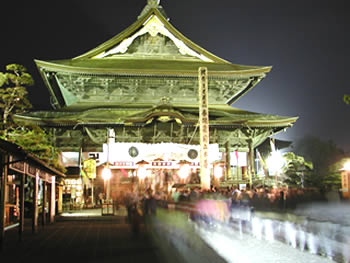
Zenko-ji temple at night.
I began my discussion by stating how from the point of view of the brain's mechanism lacking the functionality of vision is not a simple case of deprivation. When you take one functionality from the brain, something else fills that space. It is not like "normal" people are on a 100 and blind people are, say, on 10 less. The "normal" and the blind are both on 100, with different compositions of functionalities.
There are worlds open to you only when you become blind. I remember the time when I visited the famous Kaidan-Meguri in Zenko-ji temple. In this ancient temple, you are led into an underground vault, which is totally dark. You cannot see anything, and you try to touch the "key to the paradise" hidden somewhere in the passage. The condition is supposed to symbolize the helpless condition of men before the almighty in this world.
When I was there, I was struck by the surprisingly rich wave of sensations and feelings that arise from walking in the dark, searching and touching with the hand in a hesitating and careful manner. For example, your forehead feels like it is burning, presumably expecting something to hit that part, should some obstacle be in your way. Although the search for the key to the paradise was not easy, I enjoyed the whole process.
When I came out of the pitch-dark vault, I was refreshed by the summer sunshine and wind. I reflected on what I had just experienced, in a totally sightless condition. I pondered on the contrast between inside and outside the vault. Then I suddenly realized that for a blind person there wouldn't have been a single difference. For them, the world would have been a continuous and homogenous condition of sightlessness, and they would not have noticed the transition. I realized what blessings I had as a sighted person, and at the same time appreciated the existence of a whole world that I missed.
Tourist guide to the Zenko-ji temple and other attractions in the vicinity
Zenko-ji temple at night.
Subscribe to:
Comments (Atom)